







Crowd Control and Pedestrian Barriers
Crowd control barriers, also known as pedestrian barriers or crowd barriers, guide foot traffic along a set route and keep the public out of restricted areas, from a building site footpath to the entrances of a large music festival. The range covers galvanised and powder coated steel barriers with fixed or loose legs, anti-climb police barriers, hi-vis barriers and HDPE plastic pedestrian barriers. Basic and advanced walkthrough crowd barriers mark controlled access points on construction sites and at events, and connect to a run of standard barriers with hooks and eyes.
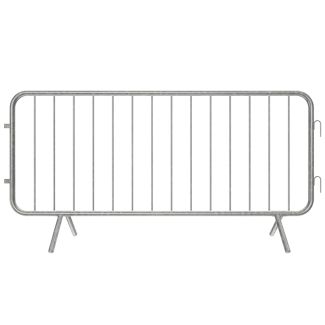
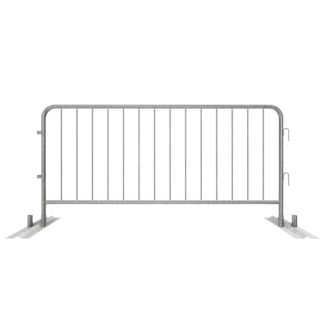
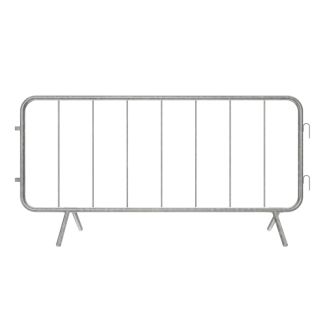





Crowd control barriers: fixed leg or loose leg
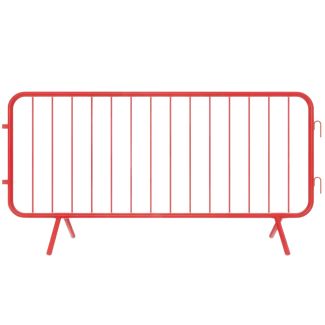
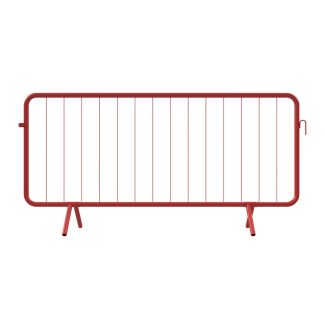
The galvanised steel barrier makes up most of the range, and the first choice is how it stands. Fixed leg crowd control barriers have offset legs welded to the frame, so each panel arrives ready to stand, needs no feet or other accessories and copes with uneven ground. The offset legs also let the panels stack neatly, which suits crews who put runs up and take them down at short notice. Eco crowd control barriers are the same fixed leg format with fewer infill bars, which cuts transport volume on large orders, and powder coated crowd barriers are the fixed leg barrier finished in colour.
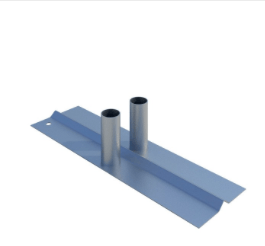
Loose leg crowd control barriers stand in separate flat metal feet, with each foot joining the two panels that meet over it. A straight run therefore needs one more foot than the number of barriers. Legs and panels are stored apart, the panels stack flat, and loose leg is the only format in the range made in a longer panel as well as the standard length. Loose leg suits barriers bought in bulk, stored between jobs and sent out by the lorry load, while fixed leg suits runs that move often and crews who want nothing extra to load.

Pedestrian safety barriers: hi-vis, plastic, police and walkthrough
Hi-vis pedestrian barriers
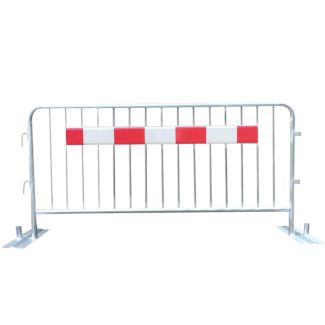
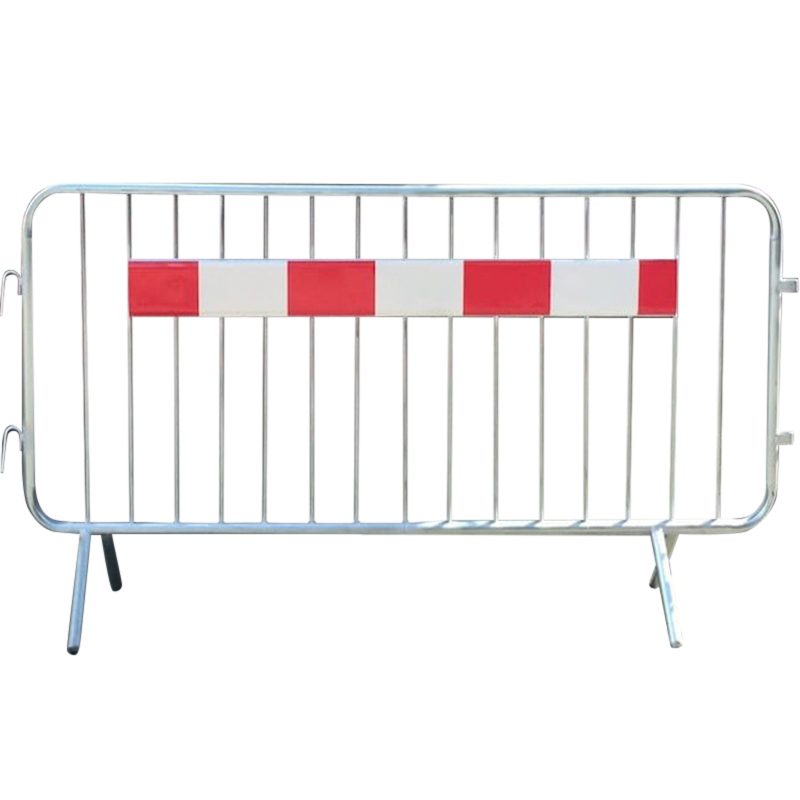
A reflective strip mounted on a steel plate makes these barriers easy to pick out in headlights and street lighting, which matters on footpaths and site walkways used after dark or in poor weather. Hi-vis pedestrian barriers come in fixed leg form and as loose leg hi-vis barriers, so the same fixed or loose leg choice applies to them.
Plastic pedestrian barriers
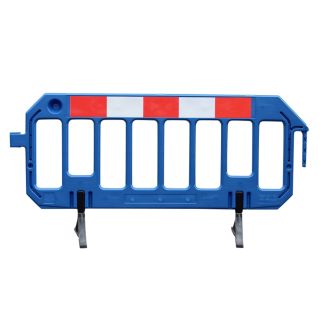
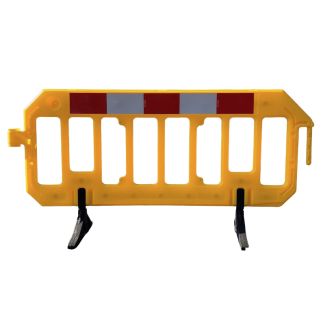
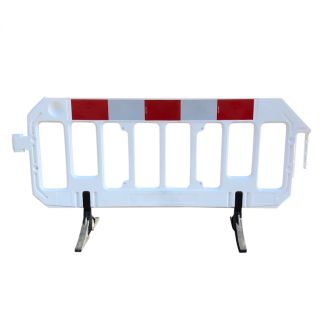
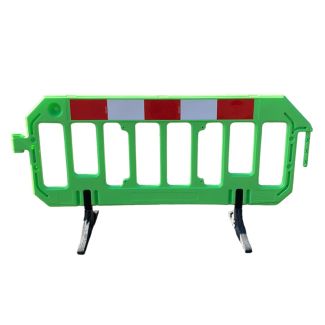
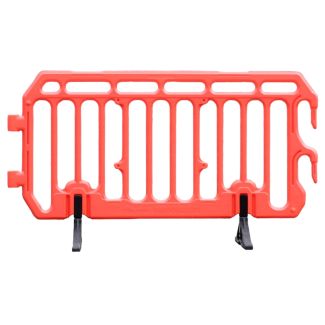
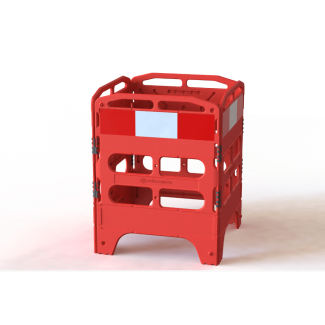
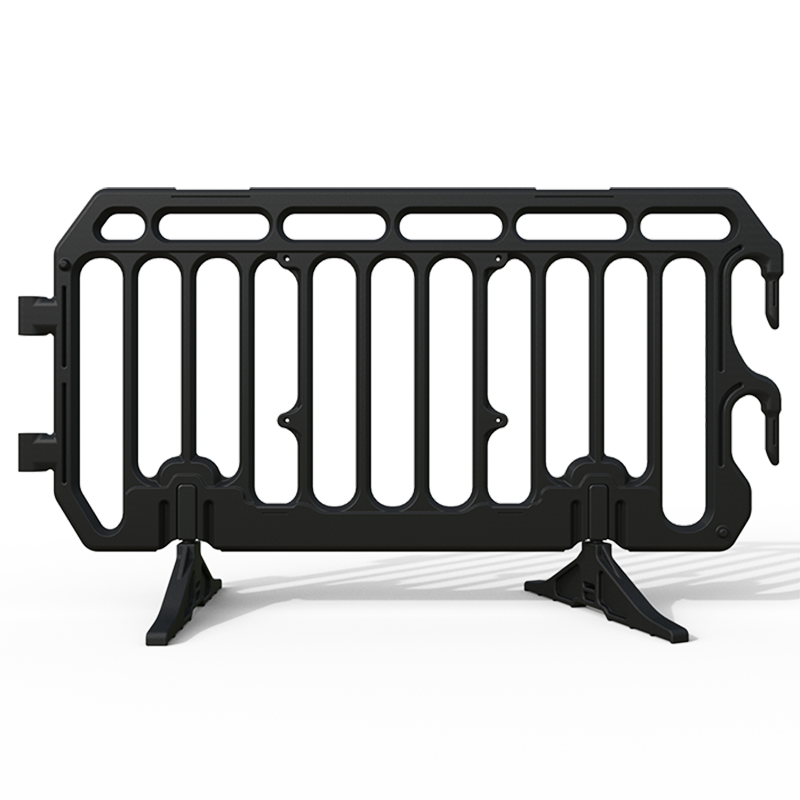
HDPE barriers suit public-facing runs where people brush past all day, such as town centre walkways, venue entrances and queues, because the panels have no sharp edges and are less of a target for theft. They can also be colour coded by zone or by contractor. The range covers grey plastic crowd control barriers and orange plastic pedestrian safety barriers where high visibility is the priority.
Dodd wire crowd barriers
Wire infill makes Dodd wire crowd barriers a lighter panel for marking walkways, safe zones and access points inside a construction site. They suit long internal runs that site teams handle and move often.
Met Police barriers
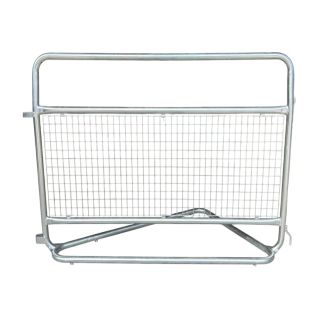
Anti-climb mesh replaces the vertical bars on Met Police barriers, so the run is hard to climb or reach through. They are the heavy-duty galvanised barrier for perimeters at large public events, stadium approaches and processions.
Walkthrough crowd barriers
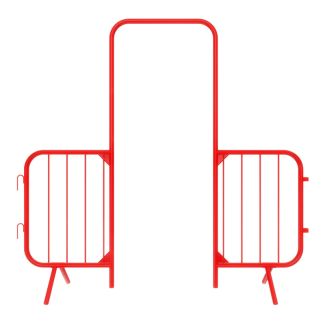
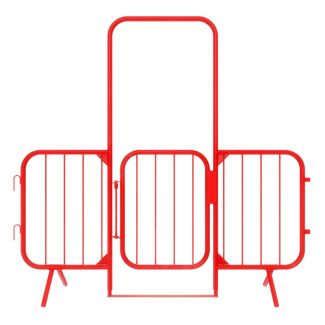
A walkthrough panel sits within a run of standard barriers and marks the point where people are allowed through, with an open hoop built into the frame. Basic walkthrough crowd barriers leave the opening clear for constant foot traffic, while the walkthrough barrier with a spring-loaded gate closes behind each person and suits staff access points and site entrances that should stay shut between users.
Expandable safety barriers
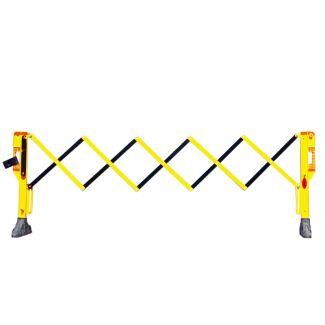
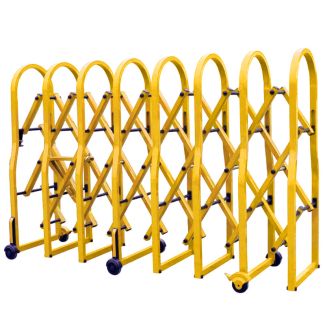
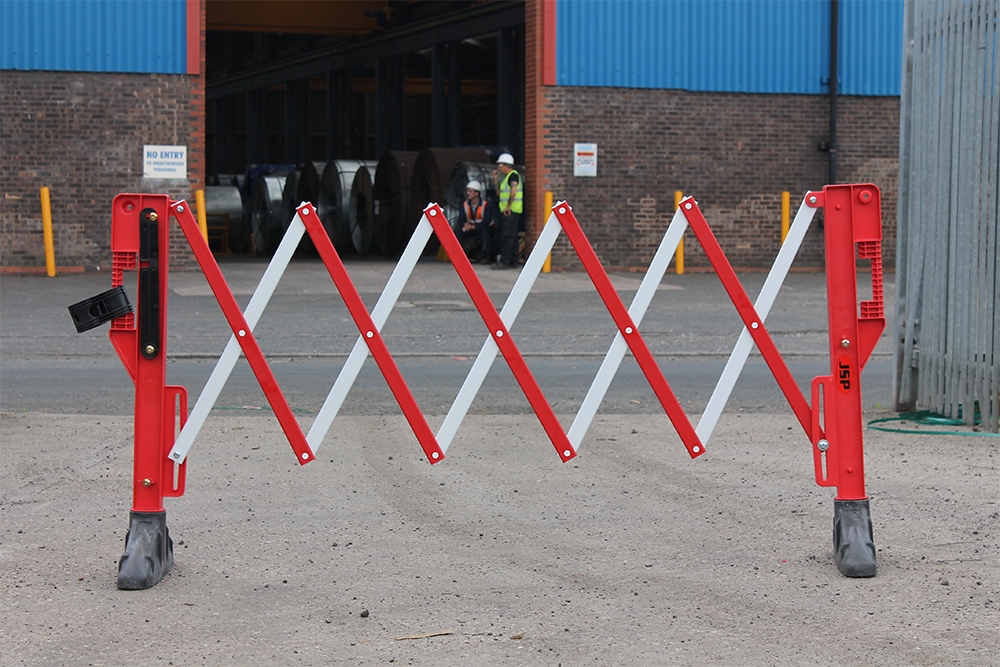
For a short-term hazard such as an open manhole, a spill or a doorway under repair, expandable barriers pull out across the gap and close up small for storage. The Titan expandable safety barrier is the portable choice for maintenance and facilities teams, and the aluminium concertina barrier closes off entrances and exits.
Front of stage barriers
A front of stage barrier enclosure is built from straight and angled sections that link into a continuous line in front of a stage, with internal and external angles to follow its shape. It is the barrier for festivals and outdoor concerts where the crowd presses forward.
Metal and plastic crowd barriers
Steel and plastic are the two main materials across the range, and the work decides between them. Most metal crowd control barriers are steel galvanised to EN 10244-2, a zinc coating that protects the steel against rust outdoors. Powder coating adds colour over the steel in red, white, black, blue and green, and fixed leg barriers can be powder coated to other RAL colours on request, which lets an event colour code its zones or match a venue's look. The front of stage enclosure is stainless steel, and the concertina barrier is aluminium.
The plastic barriers are moulded from virgin HDPE, which is fully recyclable, has no screws or rivets to work loose and can carry embossed company identification. Steel suits heavy, repeated use on sites and at events, where barriers are stacked, loaded onto lorries and left out for weeks at a time, and plastic suits public-facing runs on footpaths and in town centres.
Crowd barriers for construction sites, events and public spaces
The type and finish change with who walks beside the run and how long it stays in place.
Construction sites and footpath diversions
Galvanised fixed leg barriers are the usual choice for site walkways, welfare routes and material compounds, with hi-vis panels on the stretches that face a road. On a footpath diversion, the run should be continuous with no gaps where the public could stray into the works, the ends should return to a kerb, wall or hoarding, and the route should stay wide enough for buggies and wheelchairs. Crowd barriers mark and guide foot traffic and are not built to stop a vehicle, so where a walkway runs beside live traffic, separate the two with traffic barriers, water filled road barriers or concrete barriers, and lay out roadworks to Chapter 8 of the Department of Transport's Traffic Signs Manual.
Festivals, concerts and sporting events
Event perimeters combine several types: Met Police mesh panels on perimeters that must be hard to climb, walkthrough gates at entrances and steward access points, and standard steel runs for queuing lanes and back-of-house areas. Front of stage enclosures sit within the wider stage barriers range. Count barriers against the site plan and the event's crowd management plan, so that every entrance and emergency exit has its gate or opening before the build starts.
Queues and indoor venues
Indoor queues, reception areas and retail spaces need a lighter, neater line than steel panels, and that line comes from the retractable belt posts in the belt and rope barriers range. For queues outside, Tensabarrier outdoor posts have a base that is filled with sand or water for weight.
Crowd barrier feet, ballast, covers and stillages
Feet for loose leg barriers
The flat metal feet for loose leg barriers come galvanised or powder coated to match the panels, and the same feet also suit transit barriers.
Ballast for exposed and covered runs
A run on an exposed site or across an open car park in high wind needs weight at the feet, and so does any barrier carrying a printed cover, scrim or sign, because the cover turns an open panel into a sail. Barrier ballast bags are sand-filled PVC bags that strap to the frame, crowd barrier ballast blocks are plastic-coated concrete weights in a highly visible shell, and Dropblock ballast weights are a plastic alternative to sandbags that hooks onto barriers, fences and temporary signs.
Barrier covers and jackets
Printed crowd barrier covers turn a run into sponsor branding, project signage or a visual screen, and are made for both lengths of steel barrier. They come in PVC mesh, PVC banner and polyester airmesh, and every grade is B1 fire rated. Air permeable mesh lets more wind through than a solid banner, and continuous scrim covers a whole run in one length.
Stillages, trolleys and dollies
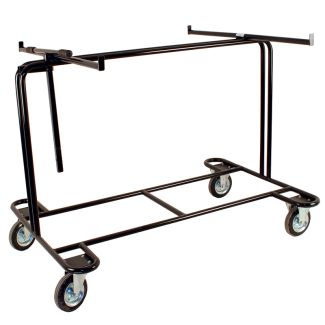
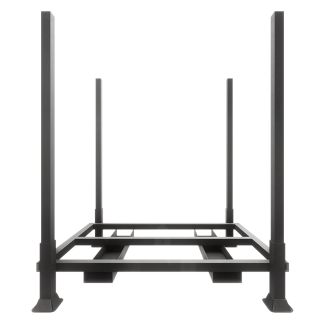
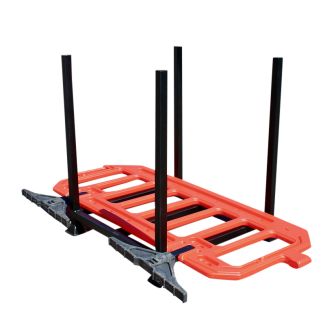
Crowd barrier stillages hold steel barriers in a stack for storage and for lifting onto a lorry, with forklift guides as an option. A crowd barrier trolley moves and stores crowd control, road and pedestrian barriers around a yard or site, and a barrier transport dolly moves stage barrier sections by hand during an event build.
Popular Categories

Traffic Barriers
View Products >

Expandable Barriers
View Products >

Water Filled Plastic Road Barriers
View Products >
Frequently Asked Questions
Most steel crowd control barriers are 1.1m high and 2.3m long, and the loose leg barrier is also made in a 2.5m length. The plastic pedestrian barriers are 1.1m high and 2.0m long. Walkthrough panels stand taller to frame the opening and the Met Police barrier is a shorter, deeper panel, and each product page gives exact dimensions.
Divide the length of the run by the panel length and round up. Each access point takes a walkthrough panel in place of a standard one. Add spare panels for returns at the ends of the run and for closing off side routes. For loose leg barriers, order one more flat metal foot than the number of barriers.
Steel crowd barriers join with hooks on one end that drop into eyes on the next panel, so a run goes up without tools or clamps. Walkthrough panels have hooks and eyes at each end and join the same run as the standard barriers. The plastic pedestrian barriers link panel to panel in the same way.
Yes. The hook and eye joint lets each panel sit at its own angle to the next, so a run can follow a slope, a kerb line or rough ground. On soft or sloping ground, set each panel so its feet sit firm before connecting the next one.
On a construction project, the project supervisor for the construction stage (PSCS), appointed under the Safety, Health and Welfare at Work (Construction) Regulations 2013, coordinates safety arrangements during the works. Pedestrian routes, segregation and site access are set out in the construction stage safety and health plan, which the PSCS develops from the preliminary plan prepared by the PSDP. Barrier runs are laid out to that plan.
Crowd barriers are waist-height, free-standing panels that guide people and mark routes, and they are quick to move as a job changes. Temporary mesh fencing uses taller panels set in weighted fence feet and clipped together to secure a perimeter against entry, such as a site boundary left unattended overnight. Many sites use both, with fencing around the works and crowd barriers along the walkways.