







Geomembranes & Pond Liners
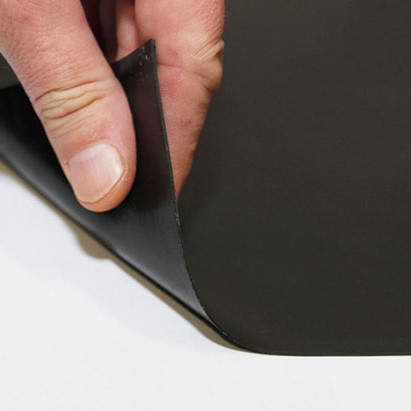
HERMEQ geomembranes are impermeable liners that control the movement of water and other fluids in civil engineering and environmental projects. The range covers PP, LLDPE and Proflex polymer sheets, EPDM rubber pond lining and a high visibility marker membrane. The containment liners are made to stay flexible, resist puncture and stretch with the ground beneath them. They line ponds, lagoons, canals and dams, hold back solid and liquid waste, and form a barrier layer on contaminated land during construction and land reclamation. Rolls and panels come in several widths and thicknesses, from narrow rolls for trenches and tank wrapping to wide sheets for open basins.


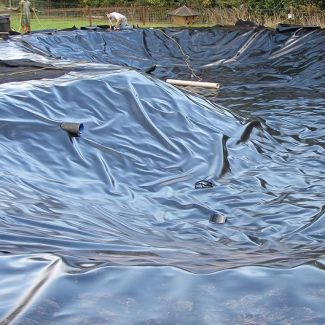
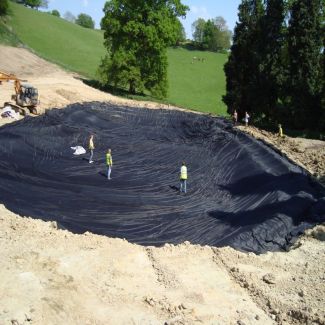

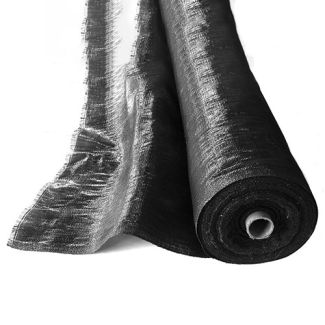


Geomembrane liners in PP, LLDPE, Proflex and EPDM
Four of the five types are containment liners that hold water or contamination in place, and the fifth, the high visibility membrane, is a marker layer that warns anyone digging later of what lies beneath it. Specifications and tenders also call the containment sheets geomembrane lining, impermeable liner or construction liner.
PP geomembrane
The PP geomembrane is a polypropylene liner for civil and water work: canal and watercourse lining, dams, amenity lakes and balancing ponds. It is also the sheet for wrapping attenuation tanks and for laying as a barrier layer on contaminated land, and it contains solid and liquid waste. Choose it for schemes where the liner carries water or keeps contamination in the ground.
LLDPE liner
An LLDPE liner is made from linear low-density polyethylene, the flexible grade of polyethylene sheet, and is also sold as an LLDPE geomembrane or polythene liner. It is made for stabilising earth and for containing solid and liquid waste, so it suits cells, bunds and lagoons where the liner keeps material in and the ground around it secure.
Proflex elastic geomembrane
The Proflex elastic geomembrane is a propylene and ethylene copolymer made for improved elasticity. Choose it where the liner has to follow a shaped formation, turn corners and slopes, or move with settling ground without being pulled tight.
EPDM rubber pond liner
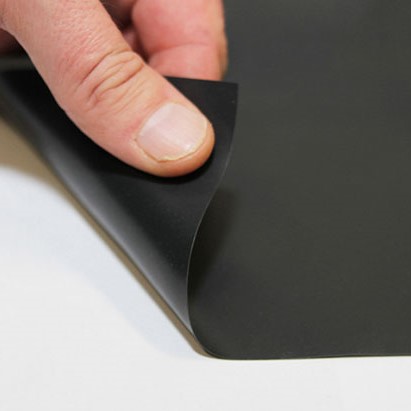
The EPDM pond liner is Sealeco Greenseal, a synthetic rubber geomembrane made in panels to cut down jointing on site. It is the rubber pond liner for golf ponds, attenuation ponds, swimming ponds and lagoons. Choose it when the pond is designed as a landscape feature as much as a water store.
High visibility marker geomembrane
The high visibility marker geomembrane is a warning layer for reclaimed industrial land. Laid over buried hazards, its colour tells future contractors and excavators that they have reached contaminated ground before the bucket goes through it. Where the site also needs a barrier, choose a containment liner such as the PP geomembrane and lay the marker membrane above it.
Pond liners, tank wrapping and waste containment
Attenuation, balancing and golf ponds
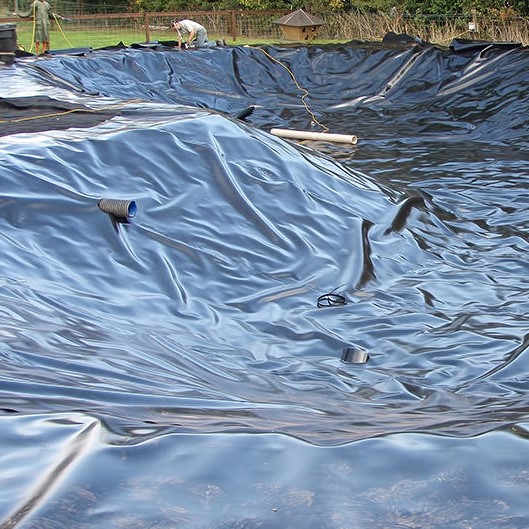
On a trade-scale pond the liner is carried up past top water level and buried in an anchor trench or under the bank finish, so that no sheet is left exposed at the waterline. Banks that take wave action, wildfowl or maintenance traffic need protecting above the liner, and water margin protection covers that zone.
Waste containment and lagoons
For waste cells and lagoons, what the liner contains comes first: slurry, leachate and process water each have their own chemistry, and the design matches the liner material to it. Gas or groundwater rising beneath a liner can lift it, and a geocomposite drainage layer under the sheet carries both away.
Contaminated land and attenuation tank wrapping
An attenuation tank is wrapped in a geomembrane so that the buried structure holds stormwater without leaking into the ground or taking in contaminated groundwater. The sheet is folded around the crates and every seam is sealed before backfill, because a wrapped tank cannot be inspected once it is buried.
EPDM rubber or polymer pond liner
For a trade-scale pond, the best liner depends on how the pond will be seen and how large and regular the basin is. EPDM rubber is the right choice for ponds built as landscape features, such as golf ponds, swimming ponds and ornamental lakes with contours, planting shelves and visible edges, because the rubber sheet folds into tight shapes and lies close against an irregular dig. A PP, LLDPE or Proflex polymer liner is the right choice for large, regular basins built as working water stores, including attenuation and balancing ponds, and for schemes where the lining continues from the pond into a canal, a ditch or a containment cell, since one material and one seaming method then cover the whole job.
Geomembrane thickness and roll sizes
Choosing a thickness
Thicknesses across the range run from 0.75 mm to 2.0 mm. A thicker sheet is the choice for a stony or uneven formation, for liners under heavier service such as deep cover soil or ice and debris on open water, and for long-term containment where the liner has to last the life of the scheme. A liner at the thinner end of the range suits a well-prepared, fine formation. Sharp stones and roots are cleared before any liner goes down, and a geotextile underlay between the ground and the sheet protects it from what remains; the same fabric laid over the liner protects it under stone or soil cover.
Roll width, panels and site joints
Roll widths across the range run from 2 m to 7 m, and the format sets how many joints the job needs. Every seam is a weld or taped joint that has to be made, tested and kept clean, so the sheet is chosen by the area and shape of the work. Narrow rolls suit trenches, tank wraps, ditches and small areas, where a wide sheet would be cut to waste and is hard to handle in a confined dig. Wide rolls and prefabricated panels suit open basins, lagoons and large ponds, where fewer, longer seams go down faster and leave fewer places for a leak to start.
Popular Categories

Geotextile Membranes
View Products >

Grass Pavers & Gravel Grids
View Products >

Geogrids
View Products >
Frequently Asked Questions
A geomembrane is an impermeable sheet that stops water, gas or contamination passing through it. A geotextile is a permeable fabric that separates soil layers, filters water and protects a liner from stones. The two are often laid together, with geotextile under and over the geomembrane.
Both are synthetic rubber pond liners, but they are different rubbers: EPDM is ethylene propylene diene monomer and butyl is isobutylene isoprene rubber. EPDM is the rubber in the Greenseal pond lining HERMEQ supplies, and it is laid, folded and jointed in much the same way.
Both are polyethylene geomembranes, separated by density. HDPE is denser and stiffer, and designers specify it where chemical resistance and long-term containment on a static base come first, such as landfill cells. LLDPE is lower in density and more flexible, so it follows an uneven formation and stretches with settling ground, which suits ponds, lagoons and containment on a base that will move.
Yes, on almost every formation. Sharp stones and roots are cleared first, and a geotextile underlay between the ground and the liner protects the sheet from what remains. Where soil or stone goes on top, a second layer of geotextile over the liner protects it from above.
Polymer sheets such as PP, LLDPE and Proflex are joined by heat: a hot wedge welder fuses overlapping sheets, and extrusion welding is used for patches, corners and pipe penetrations. EPDM rubber is joined with primer and seam tape. Welded and taped seams are tested before the liner is covered.