







RAMS Boards
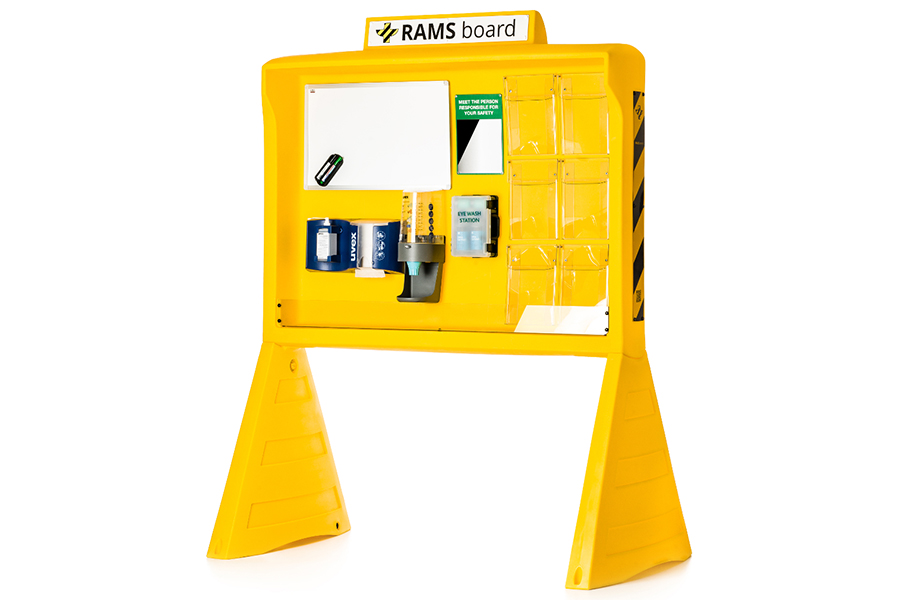
RAMS boards are site notice boards that hold risk assessments, method statements and site safety information where every trade can read them before work starts. Contractors, site managers and facilities teams set them up at site entrances, welfare areas and work compounds. This gives inductions, daily briefings and emergency details one fixed place on site, outside the cabin and in the path of the people who need them.
RAMS in construction: what the board is for
RAMS stands for risk assessments and method statements. The risk assessment identifies the hazards of a task and the controls that reduce them, and the method statement sets out, step by step, how the people doing that task will carry it out safely. On a construction site, a RAMS board holds the current versions of these documents where workers arrive, so each trade can read the controls for its own work and see what the trades around it are doing. Each employer prepares the safety statement required under the Safety, Health and Welfare at Work Act 2005. On the project, the Project Supervisor Construction Stage (PSCS), appointed under the Safety, Health and Welfare at Work (Construction) Regulations 2013, coordinates safety across the contractors during the construction stage.
What goes on a RAMS board
Most sites post the current risk assessments and method statements for every trade on site. They are grouped so that a bricklaying gang, a scaffolding crew or an electrical contractor can find its own documents quickly. Beside them go the safety statement and the site rules, from PPE requirements to pedestrian routes and restricted areas. The emergency information sits alongside: first aid contacts, the location of the first aid kit, the fire assembly point, and the name and contact details of the PSCS. A clear area for daily notices lets the site manager post the morning briefing, a change to deliveries or a new hazard.
RAMS boards at site entrances, welfare areas and compounds
The board belongs where workers stop before they start work, and larger sites often need more than one.
Site entrance and induction point
At the gate, the board is the first thing a worker or visitor sees, so it goes beside the sign-in point. People queuing to sign in then have time to read the site rules and emergency details, and whoever runs the induction can point to each document as it is covered.
Welfare and canteen areas
Gangs gather near the canteen and drying room at the start of the day and at breaks. A board there suits toolbox talks, daily briefings and changes to the programme.
Work compounds on larger sites
On large or phased sites, trades can work a long way from the gate for weeks at a time. A board in each work compound keeps the RAMS for that area close to the work, so a gang reads the method statement for the task in hand before it begins.
RAMS board size, stability and weather
Two things decide which board suits a site: how much paperwork it carries at the busiest stage of the job, and where it will stand.
Document space for the trades on site
Before buying, count the live RAMS for every trade that will be on site at the same time at the peak of the programme. Choose a board with document space for all of them at once, plus the site rules, emergency details and a briefing area. Where the count is high, two boards in different positions work better than one crowded board.
Stability on open and exposed ground
A freestanding board presents a large flat face to the wind on open ground, elevated plots and coastal sites. Plan to ballast or anchor it from the day it goes up. Ballast suits a board that will move as the work progresses, and anchoring suits a board that stays in one position.
Outdoor use for the length of the job
A board at the gate stands through rain, sun and frost for the whole programme. Choose one made from weather-resistant materials that will not rot, rust or fade over the life of the job, with a surface that cleans down with water.
Popular Categories

Acrow Props
View Products >

Builders Trestles
View Products >

Building Equipment
View Products >
Frequently Asked Questions
The Safety, Health and Welfare at Work Act 2005 and the Construction Regulations 2013 require risks to be assessed and safety information to be brought to the attention of the people at work. They do not prescribe a notice board. A RAMS board is a common way sites share that information, and the construction stage safety and health plan sets how documents are shared on each project.
Each contractor is responsible for its own risk assessments and method statements. The site manager or PSCS usually checks that the copies on the board match the current versions.
Yes. A freestanding board can be cleared down at the end of one job and set up again at the next, which suits contractors who move between projects.
Yes. Event organisers set one up during build and break to post method statements for staging and temporary structures. Facilities teams use one during maintenance or fit-out work in occupied buildings, so contractors and staff see the same safety information.
Post documents in clear, weatherproof pockets or sleeves, and print them large enough to read from standing distance. Replace any copy that has faded, curled or been written on.
RAMS stands for risk assessments and method statements. The risk assessment sets out the hazards of a task and the controls for them, and the method statement sets out step by step how the task will be done safely.